Gas Chromatography (GC) is one of the most important techniques for the separation and analysis of volatile compounds in industrial, research, and quality control laboratories. With the ability to detect chemical components at ppm to ppb levels, GC plays a critical role in industries such as oil and gas, pharmaceuticals, environmental analysis, agriculture, food industries, and advanced laboratories.
In this article by ParsiaGas, we provide a comprehensive and technical review of the GC system structure, the role of carrier gases, different types of columns and detectors, and the applications of gas chromatography in five key industries.
What Is Gas Chromatography?
Gas Chromatography (GC) is an analytical method used for the separation, identification, and quantification of volatile components in a sample. The sample (typically liquid) is injected into the system, vaporized by heat, and carried into the column by a carrier gas.
As the sample components travel through the column, they separate based on their different interactions with the stationary phase and are then detected by a detector.
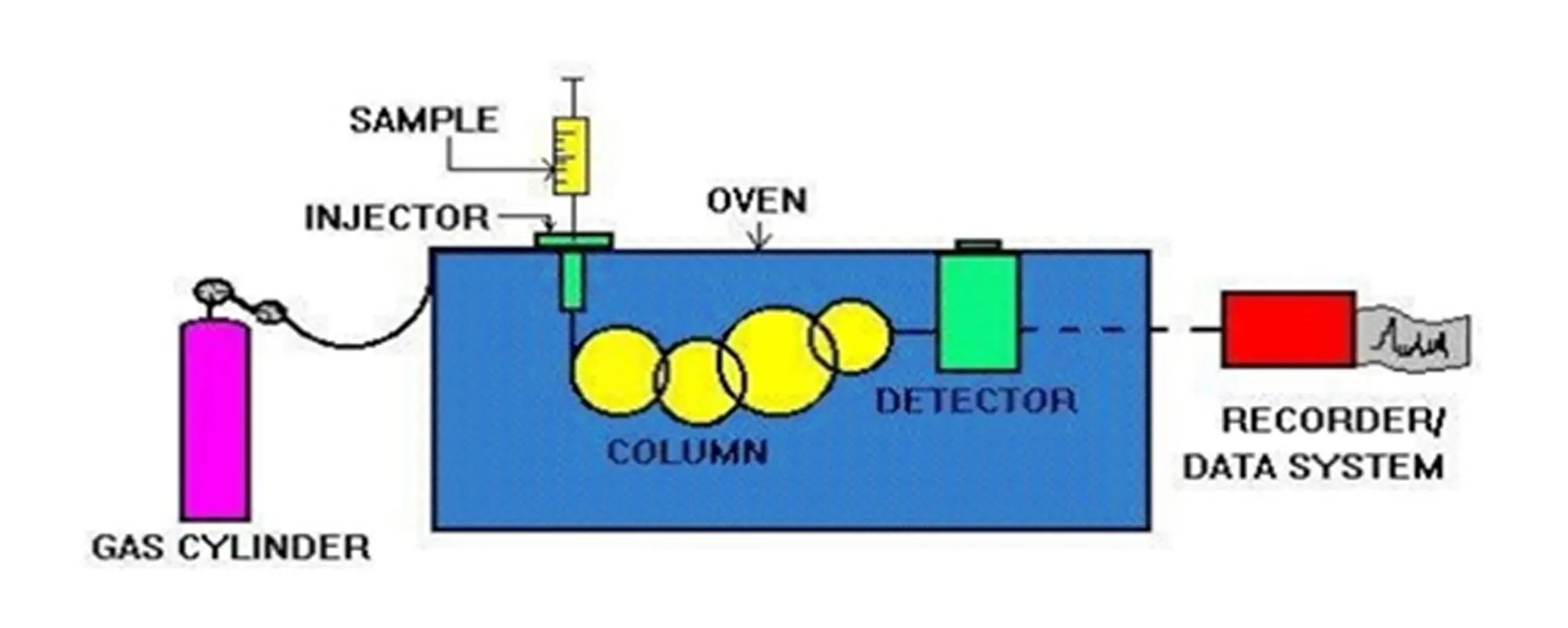
Main Components of a Gas Chromatography (GC) System
A GC device consists of the following key components:
1. Carrier Gas Cylinder
An inert and highly pure gas responsible for transporting the sample.
Common carrier gases:
| Carrier Gas | Advantages | Disadvantages |
|---|---|---|
| Helium (He) | High stability, ideal for many detectors | Expensive |
| Hydrogen (H₂) | Fastest analysis, excellent column efficiency | Flammable |
| Nitrogen (N₂) | Cost-effective, good efficiency | Longer analysis time |
| Argon (Ar) | Suitable for ECD detector | More expensive |
Required Purity: Minimum 99.999%
Presence of moisture or oxygen → Can cause noise, reduced sensitivity, and column degradation.
2. Sample Injector
This is where the sample is vaporized and introduced into the column with the carrier gas.
Injection temperature must be:
- Higher than the boiling point of sample components
- Lower than the thermal decomposition point
3. Column
The most critical part for separating components of the sample.
Two main types of columns:
| Column Type | Description | Applications |
|---|---|---|
| Packed Column | Filled with solid particles coated with stationary phase | Simple gas samples |
| Capillary Column | High-efficiency narrow tubes | Complex and precise analysis |
Types of capillary columns:
- WCOT (Wall-Coated Open Tubular)
- SCOT (Support-Coated Open Tubular)
4. Oven
Controls the precise temperature of the column.
Two operating modes:
- Isothermal – Constant temperature
- Temperature Programming – Gradual increase for multicomponent samples
5. Detector
Detects output signals from the separated components and sends them to the computer.
Most common detectors:
| Detector | Features | Use Cases |
|---|---|---|
| TCD (Thermal Conductivity Detector) | Universal – non-destructive | Inorganic gases |
| FID (Flame Ionization Detector) | Best for organic compounds | Food, fuel, pharma |
| ECD (Electron Capture Detector) | Highly sensitive to halogenated compounds | Environmental, pesticides |
Specialized Detectors:
- MSD (Mass Spectrometry Detector)
- FPD (Flame Photometric Detector)
- PID (Photoionization Detector)
- AED (Atomic Emission Detector)
How Is a Gas Chromatogram Interpreted?
The output chart of a GC analysis is called a chromatogram.
Each peak represents a single component.
- One peak → pure substance
- Multiple peaks → impure or mixed sample
The area under each peak corresponds to the concentration of that component.
Applications of Gas Chromatography in Five Key Industries
1. Oil, Gas, and Petrochemical Industry
GC is an essential tool for analyzing:
- Hydrocarbon compositions
- Natural gas (NG): CH₄, C₂H₆, C₃H₈, etc.
- Impurities such as H₂S, CO₂, mercaptans
- Analysis of LPG, gasoline, kerosene, and diesel
Common carrier gases: Hydrogen and helium
2. Pharmaceutical and Medical Industries
Used as a quality control tool for:
- Identification of organic impurities
- Determination of residual solvents
- Analysis of volatile drug compounds
- Detection of active substances in plasma and serum
Common detectors: FID and MSD
3. Food Industry
GC has critical applications in food processing, including:
- Analysis of flavorings and essential oils
- Detection of contaminants and volatile compounds
- Measurement of fatty acids and oils
- Detection of food adulteration
4. Environmental Monitoring
GC is widely used for pollution control and monitoring:
- Analysis of volatile organic compounds (VOCs) in air
- Identification of toxic substances
- Detection of agricultural pesticides in soil and water
- Measurement of halogenated compounds (using ECD)
5. Cosmetic and Personal Care Industry
Applications include:
- Analysis of fragrances and aromatic compounds
- Purity testing of solvents
- Detection of preservatives
- Identification of allergenic compounds
Why is Choosing the Right Carrier Gas in GC So Important?
Because the carrier gas directly affects:
- Analysis speed
- Detector sensitivity
- Column efficiency
- Reproducibility of results
Parsiagas supplies ultra-high purity (UHP) gases, including:
- Helium 5.0 and 6.0
- Nitrogen 5.0
- Hydrogen 5.0
- Argon 5.0
- GC calibration gas mixtures
Conclusion
Gas Chromatography (GC) is one of the most powerful techniques for analyzing volatile compounds across a wide range of industries and laboratories.
The accuracy and reliability of GC results highly depend on:
- High-purity carrier gases
- Proper temperature programming
- Correct choice of column and detector
- Regular system calibration
A Note from Parsiagas
Parsiagas, as a leading supplier of laboratory and calibration gases, provides:
- Ultra High Purity carrier gases for GC
- Standard gas mixtures for GC calibration
- Helium, nitrogen, argon, hydrogen
- Laboratory-grade regulators for GC use
- Expert consultation for selecting the proper gas for your GC system
📞 Contact our experts now for tailored technical consultation.